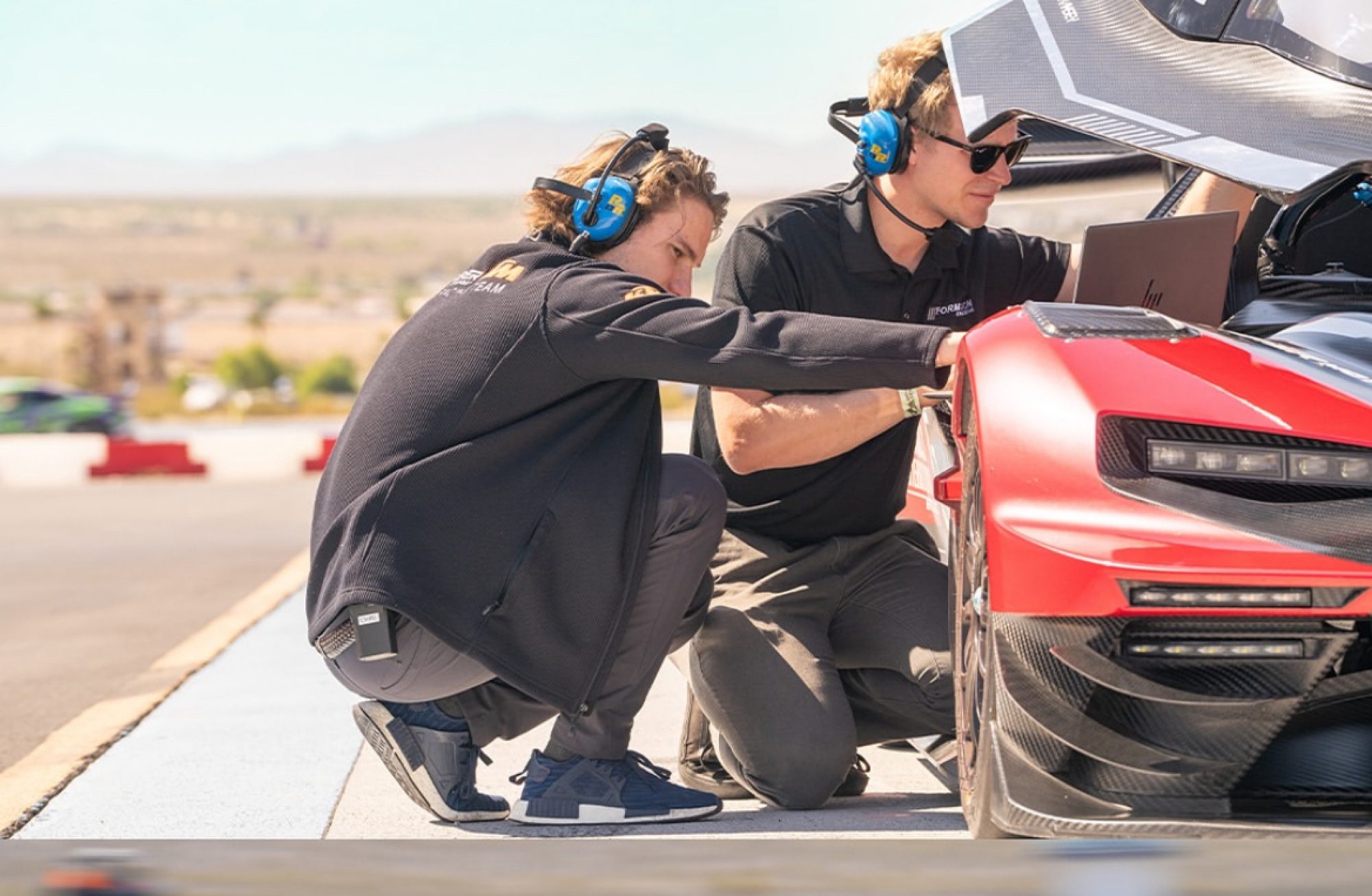

AI race engineer, human crew.
One weekend at the NASA 6 Hours of Utah: a strategy toolchain rebuilt from MATLAB to Python, calibrated against physical fuel, and run live from the pit wall, with an AI engineering session in the loop for six hours of racing.
Build
01Act I · The toolchain
The team arrived with a six-file MATLAB strategy assistant: a GUI app, a MoTeC importer, a nine-channel vehicle-health analyzer, a track library. In one day it was ported to a clean Python package with the original health-check logic preserved exactly: RPM-based oil pressure thresholds, coolant and oil temperature persistence windows, lambda versus aim, per-cylinder knock analysis. No MATLAB license required, and no logic lost in translation.
The importer was extended to parse 250 MB MoTeC exports, 188 channels at 100 Hz, tolerant of corrupt rows. Files that took the better part of a session to work through by hand parse in minutes.
Calibrate
02Act II · The numbers
Strategy is only as good as its inputs. Test telemetry became per-driver pace and fuel models. A stint optimizer weighed pit loss, refuel rate, and driver order, and quantified caution sensitivity for the fuel plan.
A 20-minute qualifying session produced verdicts before the car gridded: per-lap engine-map classification from boost data showed the 130 kPa save map was real, 0.29 liters per lap saved for 3.0 seconds, and ruled the 180 kPa map out on knock.
Then the catch that mattered most. The live telemetry stream’s fuel channel was scaled wrong by 21 percent. It was proven wrong by aligning the stream lap-by-lap against the MoTeC logger and cross-checking a physical fuel ledger: 40 liters in, 11 pumped out. Every live fuel call in the race depended on that correction, made before it could corrupt a single decision.
Race
03Act III · The live engine
During the race a live engine consumed the car’s cloud telemetry and the timing feed: fuel remaining anchored to the ECU across power cycles, rolling burn rate, pit calls in laps, the whole-race fuel balance projected to the flag, pit-lane geofencing with speed alerts, a knock alarm, and a vehicle-health strip. Two web dashboards served the pit wall. The design rule throughout: honest data. Live numbers are labeled live, estimates are labeled estimates.
Behind the pit wall, a cloud AI session ran the watch cycle every two to six minutes for six hours: box calls to the lap, stop countdowns, incident replanning. Corrections flowed both directions through a command channel, and the human crew stayed in the loop for every decision. This is how we use AI: an engineer that never gets tired, supervised by people who know the car.
Four pit stops called to the lap. Zero fuel scares. P2 in class defended.
Inquiries
Racing an endurance event and want this on your pit wall? Tell us about the car and the race.

